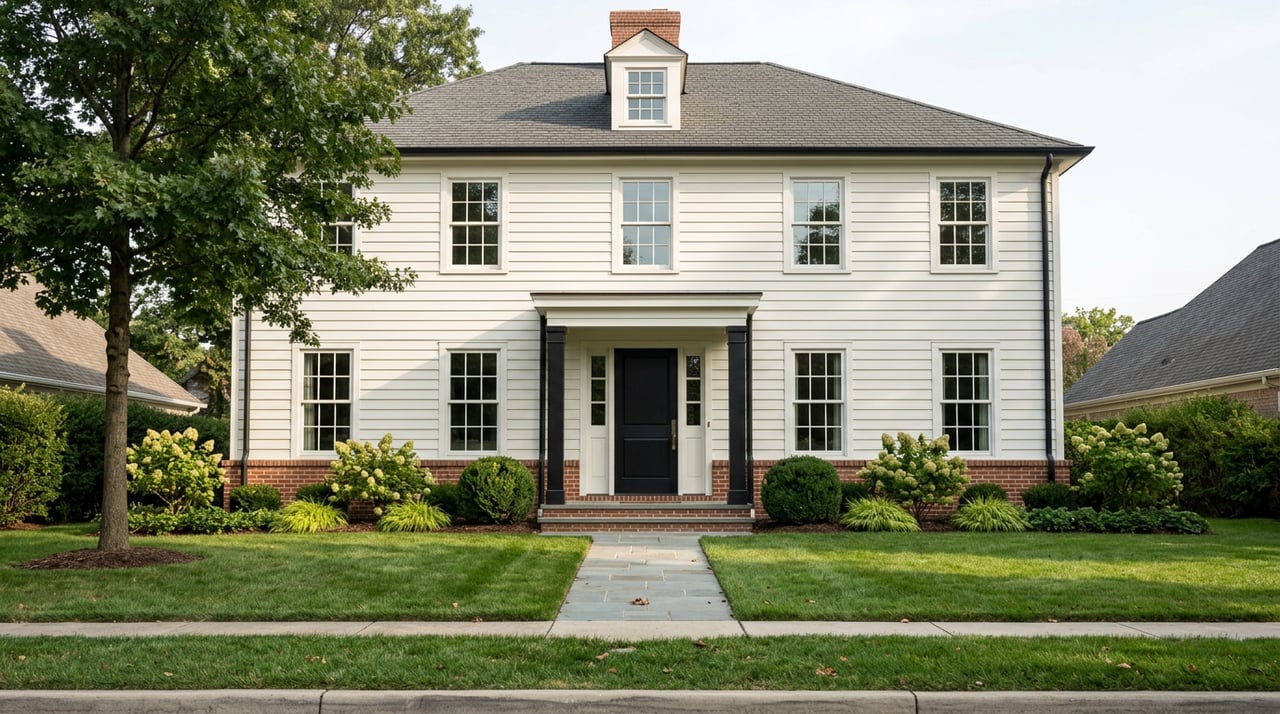
A Millburn Teardown Is Asking Close to $3 Million. The Price Isn't an Accident.
September 10, 2026
September 10, 2026
In February 2025, Vantage Builders LLC beat out more than a dozen other buyers for a two-bedroom house on Sunset Drive in Millburn's Wyoming section. The deal didn't officially close until July 17, 2025, when it recorded at $965,000, a 21 percent premium over the home's $799,000 asking price. Vantage demolished the house, and eighteen months after the purchase, a home spanning more than 5,900 square feet, with six bedrooms and six and a half baths, is nearing completion on the same 0.26-acre lot, asking close to $3 million.
That phrase, close to $3 million, is where most coverage of this deal stops. It shouldn't. The number a builder chooses to land on right around that threshold isn't a rounding decision. It's a tax decision, and understanding why tells you something about how new-construction pricing actually works in Millburn right now, not just at 7 Sunset Drive but across the wave of teardowns reshaping the town's older streets.
Vantage Builders isn't a stranger to this playbook. The firm has run comparable projects at 1 Rodman in Millburn and 501 Park Street in Montclair, with another active build underway at 16 Dale Drive in Chatham. A similar story played out in Short Hills in March 2025, when a 2,385-square-foot 1948 Cape Cod sold more than $620,000 over asking in five days, again to a buyer planning demolition and a larger rebuild.
Realtor Chrissy Schwartz, describing the pattern to Jersey Digs, put the logic plainly:
"Essex County is extremely attractive to both builders and end users."
High prices, she added, are exactly what make the investment worth it for builders willing to take on a teardown.
The land math backs her up. Single-family housing supply across Essex County fell 9.3 percent year over year to just 633 available homes in July 2026, leaving a 2.3-month supply, according to New Jersey Realtors data reported by Hoodline. A balanced market runs closer to six months of supply. When there's almost no vacant land left to build on, builders stop looking for lots and start looking for houses they can remove.
That scarcity is also why prices for what these builders produce keep climbing. Century 21 Preferred's data puts the median sale price for luxury single-family homes in Millburn and Short Hills, the $2 million to $10 million-plus tier, at $2.537 million in June 2026, up 36.2 percent year over year across 32 closed transactions. Most of that activity sits inside the exact price band where a tax rule most buyers have never heard of starts to bend the numbers.
Until July 10, 2025, New Jersey's so-called mansion tax was a flat 1 percent fee paid by the buyer on any residential sale over $1 million. A law signed by Governor Phil Murphy on June 30, 2025 rewrote that structure entirely. The fee, officially the Graduated Percent Fee, now sits with the seller, and it scales upward for anything sold above $2 million:
| Sale Price | Rate | Tax on a Sale at the Top of That Range |
|---|---|---|
| $1,000,000 to $2,000,000 | 1% | $20,000 |
| Over $2,000,000 to $2,500,000 | 2% | $50,000 |
| Over $2,500,000 to $3,000,000 | 2.5% | $75,000 |
| Over $3,000,000 to $3,500,000 | 3% | $105,000 |
| Over $3,500,000 | 3.5% | varies |
The detail that matters most for a builder pricing a spec home isn't the top-line rate. It's that each rate applies to the entire sale price, not just the portion above the threshold. A home that closes at exactly $3,000,000 owes 2.5 percent on the full amount, or $75,000. A home that closes one dollar higher, at $3,000,001, jumps into the next bracket and owes 3 percent on the full amount, or roughly $90,000. One dollar of sale price costs the seller an extra $15,000 in tax.
That's not a rounding error. It's a cliff, and it sits directly inside the range where most of Millburn's new construction is priced. A builder asking close to $3 million isn't guessing at what the market will bear in isolation. They're pricing against a wall that gets $15,000 more expensive to cross the moment they step over it.
If you're negotiating on a new-construction listing in Millburn priced near $2.5 million or $3 million, the seller's math isn't only about comparable sales. It's about which side of a tax bracket the final number lands on. An offer that nudges a sale price from $3,000,000 to $3,000,001 doesn't just add a dollar to the deal. It moves the seller into the next bracket, and the tax owed jumps by roughly $15,000, calculated on the full price rather than the extra dollar.
That asymmetry cuts both ways at the negotiating table. A seller sitting just under a bracket line has real reason to resist an offer that would push them over it, even one that looks generous on paper. A buyer who understands the mechanism has room to structure an offer that stays under the threshold in exchange for other concessions, since the seller may value staying under the line more than they value the extra few thousand dollars a slightly higher price would bring.
The law technically places responsibility for the fee on the seller for any deed recorded on or after July 10, 2025, but the party who ultimately absorbs it is still negotiable in the purchase contract. That's worth raising directly with your agent and attorney before you get to the offer stage, not after.
There's a second, slower-moving cost tied to every one of these projects that doesn't show up at closing. The Sunset Drive teardown carried an $11,218 annual property tax bill before demolition. Whatever the finished 5,900-square-foot home eventually gets assessed at will replace that number, and state tax tables published in early 2026 show 51.2 percent of every Millburn tax dollar funds the local school district, 26.4 percent supports municipal operations, and 22.5 percent goes to Essex County. That reassessment flows into a district serving roughly 5,000 students across eight public schools, which is part of why teardown activity draws more local attention than a typical resale.
Millburn officials haven't been passive about the pace of this activity. In June 2026, the township updated its zoning code through Ordinances 2645-23, 2646-23, and 2756-26, refining how residential floor area ratio gets calculated and tightening enforcement of prevailing front yard setbacks. The stated goal, per the township's own Master Plan recommendations, is controlling how large a replacement home can get relative to its lot and preserving the scale of existing streets.
For a buyer watching this market, that's a signal worth reading correctly. The next generation of teardown rebuilds may not be able to hit the same square footage as 7 Sunset Drive on a comparable lot, which could shift where new construction lands relative to those same tax brackets. A stricter FAR limit doesn't just change the house. It changes which side of the $2.5 million or $3 million line the finished product is likely to sell on.
If I'm buying, do I ever pay this tax myself? Not by default. As of July 10, 2025, the legal obligation sits with the seller. But buyer and seller can still agree in the contract to allocate the cost differently, so it's a fair point to raise during negotiation rather than an assumption to make.
Does the tax really apply to the whole price, not just the amount over the threshold? Yes. That's the detail that creates the pricing behavior described above. A sale at $3,000,000 and a sale at $3,000,001 land in different brackets, and the difference in tax owed is calculated on the entire sale price in both cases.
Is this why so many Millburn new-construction listings end in numbers like $2,495,000 or $2,995,000? The pattern is consistent with the incentive the tax creates, and it's worth asking your agent to check where a specific listing sits relative to the nearest bracket line before you decide how to structure an offer.
If you're comparing a Millburn teardown rebuild to what else is available in Short Hills, Maplewood, or Montclair, this kind of detail is exactly where a local read matters more than a national one. Allison Ziefert Homes works these streets and these price bands every week. Reach out for a Free Local Market Consultation before you write an offer that crosses a line you didn't know was there.
Blog
A practical guide for anyone considering a move to South Orange — covering train stations, jitney routes, parking, and how to match your commute to the right neighborh… Read more
Blog
For anyone considering a move to Northern NJ, or already here and wondering why the property tax bill hasn't sent them packing yet.
Blog
A mid-2026 status check for anyone buying, selling, or just curious about home values in these two Essex County communities
Blog
A practical seller's guide for homeowners in Essex, Morris, and Union Counties planning to list between September and November

Blog
For Maplewood, Montclair, Millburn, and surrounding-town residents heading to a new market — and what a great agent referral actually looks like
We are passionate about researching market stats, negotiating contracts, and helping our clients find and sell homes. The majority of our business comes from past clients and referrals from people who know our work.